Forget everything you know about “living tanks.” While most armored dinosaurs (like the Ankylosaurs) looked like rugged, low-slung armadillos, a recent breakthrough in late 2025 has officially crowned a new king of weird: Spicomellus afer.
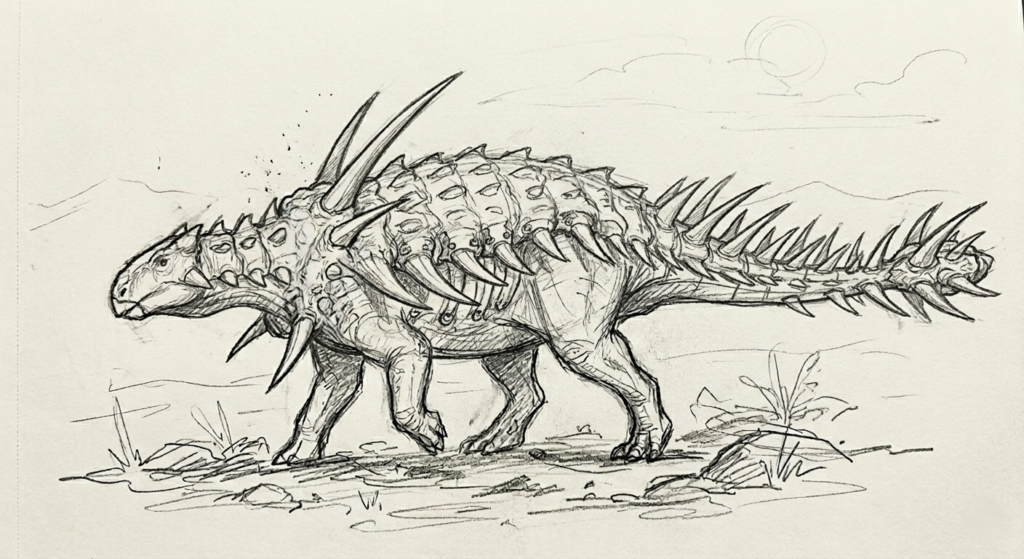
Originally discovered in the Middle Atlas Mountains of Morocco, this dinosaur was first described in 2021 from a single, mysterious rib bone. However, a major study published in the journal Nature in August 2025 revealed a nearly complete picture of the animal and it’s unlike anything else in the fossil record.
Why it’s Breaking the Internet
Spicomellus lived roughly 165 million years ago during the Middle Jurassic, making it the oldest ankylosaur ever discovered. Howeber, it’s the “fashion sense” of this dinosaur that has scientists stunned.
- The Spiked Collar: Unlike later ankylosaurs with simple plates, Spicomellus sported a heavy bony collar around its neck with meter-long spikes (about 3 feet) jutting out from the sides.
- Ribs with Attitude: In a move never seen in any other vertebrate (living or extinct) this dinosaur had defensive spikes fused directly to its ribs. Usually, armor sits in the skin. Spicomellus had it bolted to its skeleton.
- The First Tail Weapon: While the very tip of the tail is still missing, the 2025 fossils revealed “handle” vertebrae. This proves that Spicomellus likely had a tail club or weapon 30 million years earlier than scientists previously thought possible.
Display or Defense?
Paleontologists like Dr. Susannah Maidment and Professor Richard Butler suggest that these massive neck spikes might have been “overkill” for just stopping a predator. Instead, they believe this “punk rock” armor was used for display, helping the dinosaurs intimidate rivals or attract mates in the ancient Moroccan landscape.
As predators got larger and more dangerous in the Cretaceous period, armored dinosaurs eventually traded these flamboyant spikes for the thicker, more functional “tank” plating we recognize today. Spicomellus stands as a spiky reminder that evolution often starts with some very wild experiments!