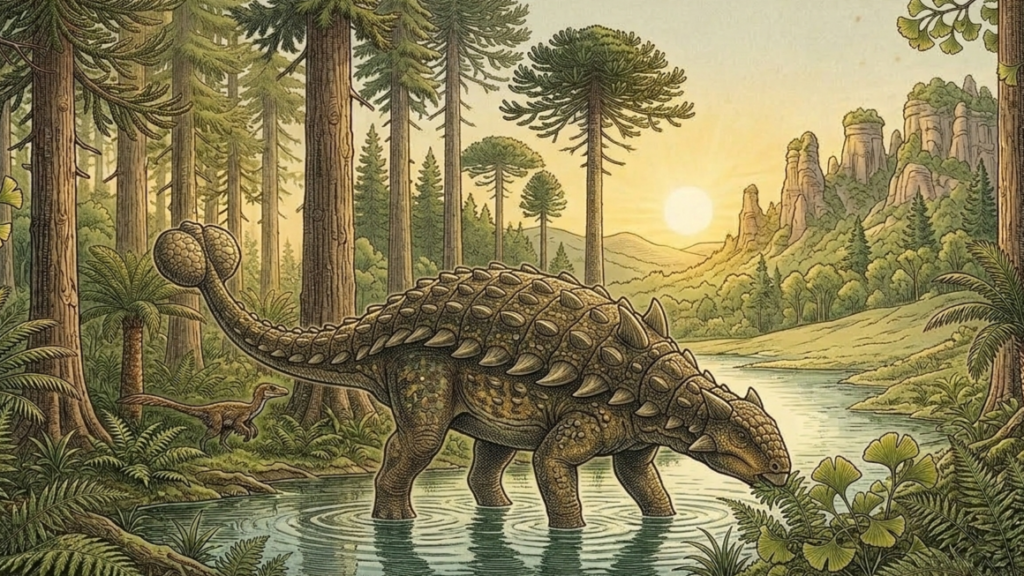
Picture a dinosaur that looked like a living tank, armored from head to tail with a massive club at the end ready to smash any predator that got too close. This is Ankylosaurus, one of the ultimate defenses in the dinosaur world during the final days of the Cretaceous.
Discovered in 1908 by famed fossil hunter Barnum Brown in the Hell Creek Formation of Montana, Ankylosaurus was named by Henry Fairfield Osborn, meaning ‘fused lizard’ for its bony armor plates that were fused to its body. These osteoderms formed an impenetrable shield, while its broad, low-slung body allowed it to bulldoze through vegetation. Fossils reveal it had a beak-like mouth for cropping tough plants and even small horns around its eyes and nose.
Weighing as much as a school bus and stretching over 20 feet long, Ankylosaurus roamed the floodplains of what is now western North America alongside giants like Tyrannosaurus rex. Its tail club, made of dense bone, could generate enough force to break the leg bones of even the largest carnivores, according to biomechanical studies. Remarkably, well-preserved specimens show evidence of vibrant coloration patterns under that armor, hinting at a more colorful life than we once imagined.
Ankylosaurus was among the last non-avian dinosaurs, with fossils found right up to the asteroid impact that ended the Cretaceous 66 million years ago. Recent discoveries, including skin impressions, confirm its scaly hide and reinforce its reputation as nature’s ultimate armored herbivore.