Picture a 12-year-old girl prying a massive fossil from the crumbling cliffs of Lyme Regis, England, in 1811. That girl was Mary Anning, and what she uncovered was the first complete Ichthyosaurus skeleton, revolutionizing our understanding of ancient marine life.
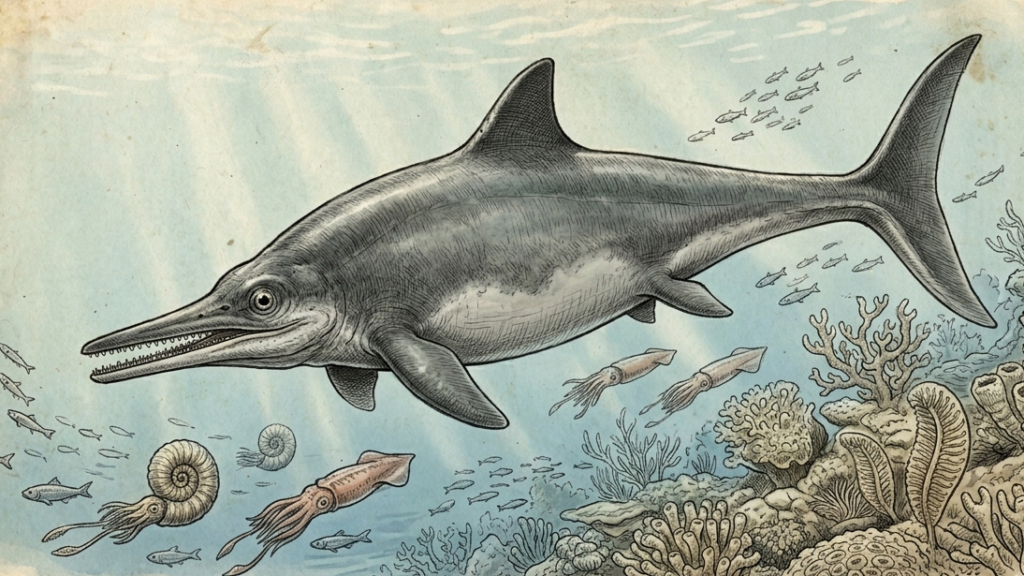
Named Ichthyosaurus, meaning ‘fish lizard,’ by naturalist Charles Koenig in 1818, this sleek predator ruled the seas of the Early Jurassic. Mary Anning went on to find more specimens, including rare fossils revealing that these reptiles gave birth to live young, just like today’s dolphins. No eggshells cluttered their nests; instead, tiny Ichthyosaurus pups emerged ready to swim.
Fossils from Lyme Regis and Germany’s Holzmaden show Ichthyosaurus hunting fish and squid with conical teeth perfect for grasping slippery prey. Recent discoveries, like a 2021 embryo fossil from the UK, offer glimpses into their reproduction, confirming head-first births to prevent drowning.
Though not a dinosaur but an ichthyopterygian reptile, Ichthyosaurus captivates with its dolphin-like form adapted for speed, reaching bursts up to 22 mph. Its story, intertwined with Anning’s groundbreaking work, reminds us how one fossil can rewrite history.
Note: As mentioned, the Ichthyosaurus was technically not a dinosaur. However, I’ve decided to include it in my dinosaur encyclopedia anyway because it’s widely recognized as closely associated with popular dinosaurs.