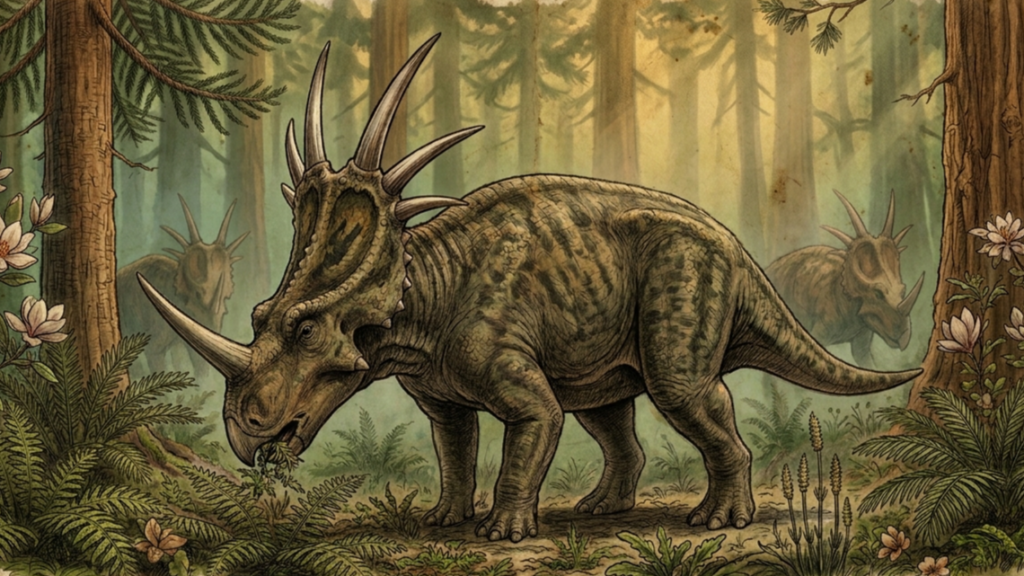
Picture a massive rhino-like beast charging through ancient floodplains, its head crowned with a dramatic array of long, sharp spikes and a towering nasal horn. This is Styracosaurus, one of the most striking ceratopsians ever to roam the Earth.
Named in 1913 by Canadian paleontologist Lawrence Lambe, Styracosaurus albertensis was first unearthed by Charles H. Sternberg along the Red Deer River in Alberta, Canada. Over 50 specimens have since been discovered, making it one of the best-known horned dinosaurs. Its massive frill, up to 6 feet wide, was adorned with four long spikes curving outward, possibly used for display, defense against predators like Daspletosaurus, or even intra-species combat.
Recent studies reveal fascinating details about its life. Skin impressions from a specimen show a mosaic of polygonal scales and tubercles, hinting at a tough, armored hide similar to modern crocodiles. Styracosaurus likely lived in herds, browsing on low ferns, cycads, and horsetails in coastal floodplains teeming with life.
Computed tomography scans of its skull suggest powerful jaw muscles for grinding tough plants, underscoring its role as a dominant herbivore in its ecosystem 75 million years ago.