Imagine a dinosaur so bizarre it vanished into thin air during World War II, only to resurface decades later as a swimming predator. Let’s dive into how this lost beast rewrote paleontology books and inspired blockbuster movies!
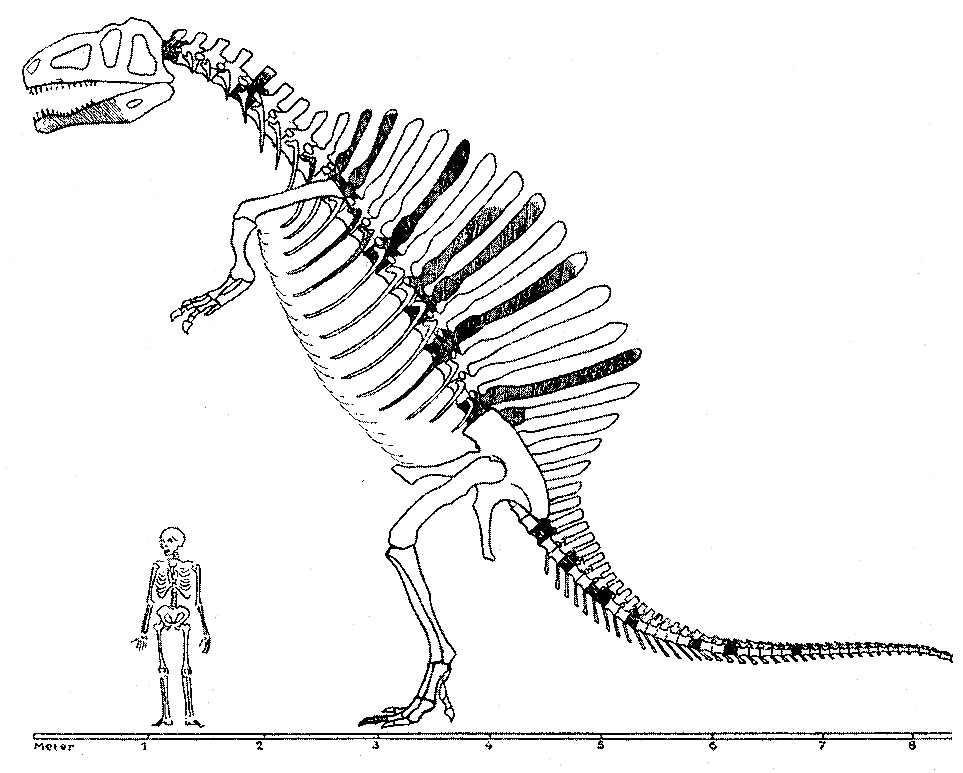
Lost in the flames of WWII, the Spinosaurus was history’s greatest dinosaur mystery. Discovered in 1915 by Ernst Stromer in Egypt, its fossils were destroyed in a 1944 bombing. Fast-forward to 2014: New bones in Morocco reveal a semi-aquatic giant with a sail-like fin, longer than T. rex, hunting in rivers like a croc-dino hybrid. This epic comeback changes everything we know about dinosaurs!
The Spinosaurus saga begins in the early 1900s when German paleontologist Ernst Stromer ventured into the Egyptian desert. In 1912, he unearthed fossils that would redefine prehistoric predators: a massive theropod with a distinctive sail on its back, measuring up to 50 feet long. Named Spinosaurus aegyptiacus in 1915, it was initially thought to be a land-dwelling carnivore similar to T. rex but even larger.
Tragedy struck during World War II. In 1944, Allied bombs hit the Munich museum housing the only known Spinosaurus specimens, incinerating them completely. For decades, scientists relied on Stromer’s drawings and descriptions, piecing together a puzzle with missing pieces. The dinosaur became a legend, even appearing as the main villain in Jurassic Park III, though inaccurately portrayed as a land hunter.
The plot twist came in 2014 when paleontologist Nizar Ibrahim led an expedition to the Kem Kem beds in Morocco. They discovered new fossils, including a tail that proved Spinosaurus was adapted for swimming, with a flexible tail fin for propulsion in ancient rivers. This revelation turned it into the first known semi-aquatic dinosaur, challenging old ideas about how these giants lived.
This story highlights the resilience of science against war and time. For more, check out the original 1915 description by Stromer in Abhandlungen der Königlich Bayerischen Akademie der Wissenschaften, and Ibrahim’s 2014 paper in Science journal (DOI: 10.1126/science.1258750). You can also visit the Natural History Museum in London for related exhibits.