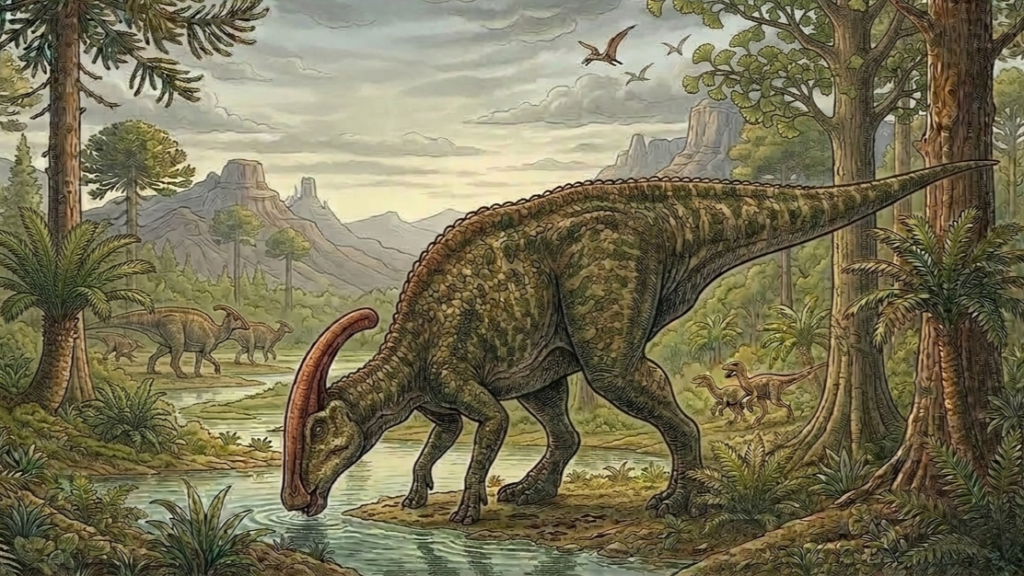
Imagine a dinosaur whose head was a built-in musical instrument, blasting calls that reverberated across prehistoric landscapes. Parasaurolophus, the ‘near crested lizard,’ was a sight to behold in the Late Cretaceous.
In 1920, Charles Mortram Sternberg discovered the first fossils in Alberta, Canada, within the Dinosaur Park Formation. William Parks named it in 1922, puzzled by its elaborate crest. Early theories ranged from snorkels to sails, but CT scans now confirm it functioned as a resonance chamber for low-frequency honks and whoops.
These social herbivores likely lived in herds, browsing on conifers, horsetails, and ferns. Fossils from Utah, New Mexico, and Wyoming reveal individuals up to 30 feet long, with evidence of pathologies like infections that they survived.
Recent studies even model the sounds: deep, foghorn-like blasts for mating displays or predator alerts, making Parasaurolophus the brass section of the dinosaur orchestra.