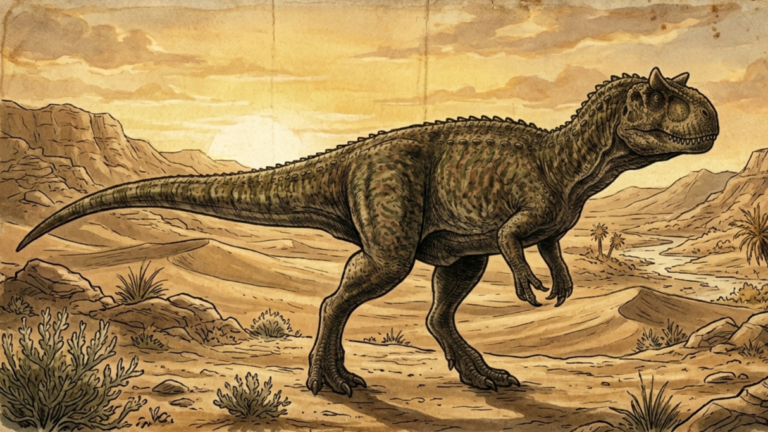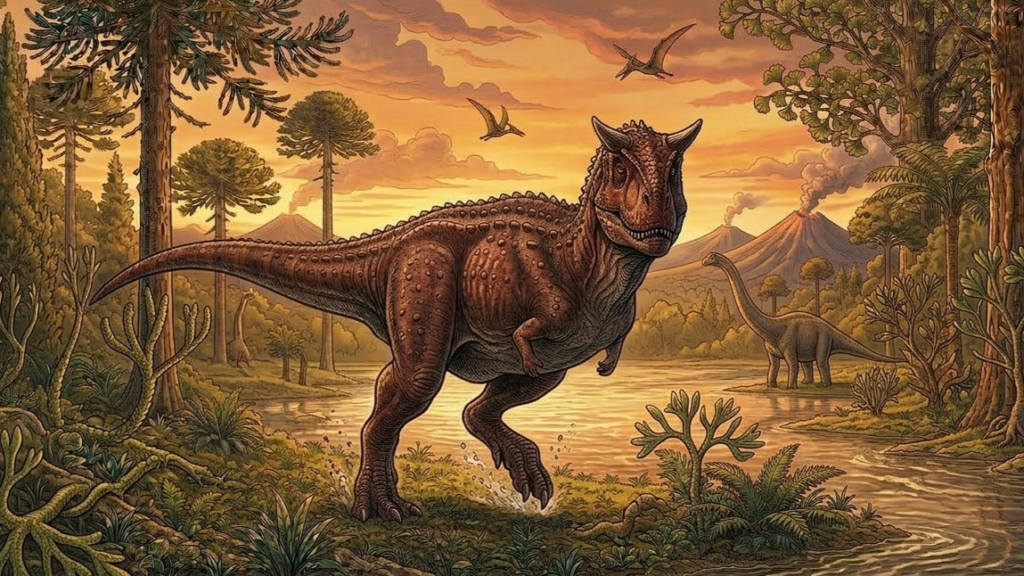
Picture a ferocious predator with bull-like horns charging through prehistoric forests, its tiny arms tucked uselessly at its sides. This is Carnotaurus, one of the most uniquely preserved dinosaurs ever found.
Discovered in 1984 by Argentine paleontologist José F. Bonaparte in the La Colonia Formation of Patagonia, Argentina, Carnotaurus sastrei was named for its distinctive horns resembling those of a bull. The nearly complete skeleton, over 80% intact, revealed astonishing features like an extremely short, deep skull built for powerful bites, and arms so small they make T. rex look buff by comparison, ending in four slender fingers.
This abelisaurid thrived in a lush, riverine environment about 70 million years ago, likely using its speed, estimated at up to 30 mph, to hunt large prey like titanosaurs. Fossilized skin impressions show a pebbly, armor-like texture with large bumps, mimicking modern crocodiles and suggesting a tough hide.
Recent studies highlight its role as a top predator in Gondwana, with biomechanical analyses showing a bite force strong enough to crush bone. Carnotaurus continues to captivate scientists, bridging gaps in our understanding of southern hemisphere dinosaurs right before the asteroid impact.