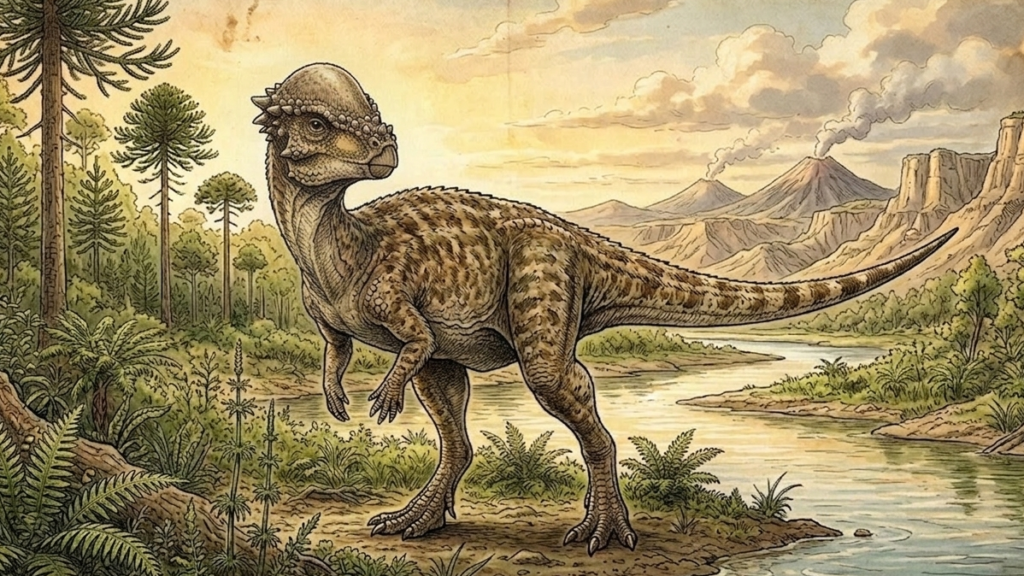
Picture a dinosaur armored with a skull dome up to 10 inches thick, built like a living battering ram from the twilight of the dinosaurs’ reign. Pachycephalosaurus roamed the floodplains of Late Cretaceous North America, its massive head a mystery that has puzzled paleontologists for decades.
Discovered in 1923 by Charles Sternberg in Alberta, Canada, it was formally named in 1931 by William Parks from a nearly complete skull. Fossils have since turned up in the Hell Creek Formation of Montana and Wyoming, the same rock layers that yield T. rex and Triceratops. Early theories suggested these head-butters slammed into rivals like bighorn sheep, but modern studies reveal the skull’s internal structure couldn’t withstand such impacts. Instead, evidence points to flank-butting or vibrant display colors on the dome for attracting mates or intimidating foes.
Recent discoveries include skin impressions showing a mix of scales and tubercles, hinting at a more rugged appearance than previously thought. As one of the last non-avian dinosaurs before the asteroid strike 66 million years ago, Pachycephalosaurus offers a glimpse into the diverse ecosystems that once thrived alongside apex predators. Its plant-munching habits, inferred from jaw structure and gastroliths found nearby, paint it as a browser of ferns, cycads, and early flowering plants.